

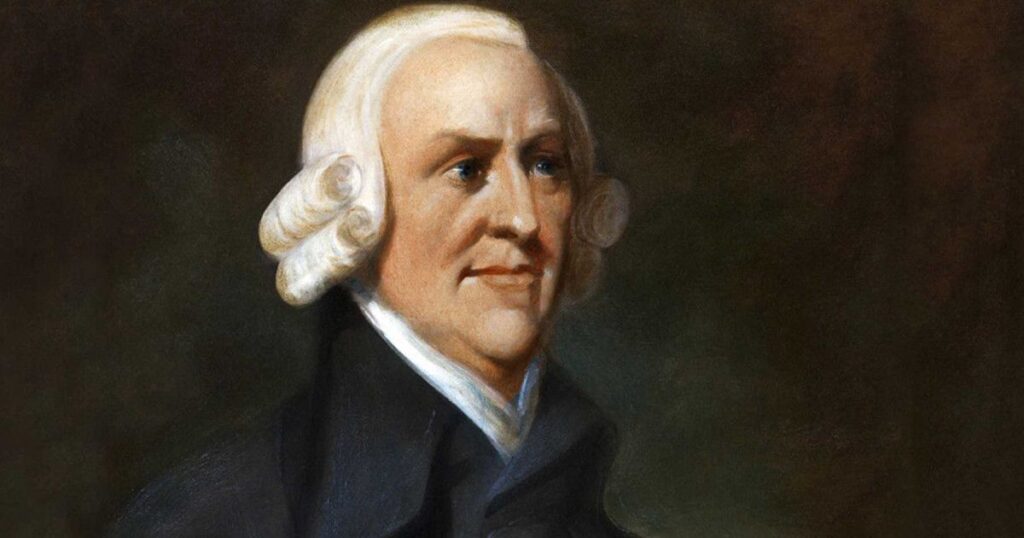
This month marks the 250th anniversary of the publication of The wealth of nations From Adam Smith, the most relevant work in the history of economic thought. In simple terms, what Smith set out in that book was that the system of natural freedom, that is, the one in which people are free to decide what to do with their talents, labor, and property, generates a spontaneous order, that is, not directed by any central authority, which increases overall prosperity. That is the famous invisible hand so often misinterpreted by socialists of all eras, who do not conceive the possibility that people are better off in an order of voluntary collaboration rather than one directed by enlightened leaders. Smith’s liberal philosophy led to an ethic of equal dignity or “equal rights” as stated by Deirdre McCloskey, being essential to overcome the widespread situation of poverty in which humanity lived. Demonized by the left and intellectuals of the time, the capitalist industrial revolution allowed an immediate improvement in the quality of life of the masses as clearly explained in the introductory book on economics La gran evasión by Pablo Paniagua and Felix Muñoz. However, to this day this is a truth resisted. A recent work by Phill Gramm and Donald Boudreaux on myths surrounding capitalism magistrally explains the historical falsehoods that were established around that era. That people had better lives in the countryside before moving to cities to work in industries is one of those myths. From the fall of the Roman Empire in 476 until the 18th century, the quality of life of the average worker hardly improved at all. Until 1800, 18% out of every 100 children died in their first year of life and only 69% reached the age of 15. This dramatic reality affected all social classes. Queen Anne of England, who died in 1714 at the age of 49, had seventeen pregnancies and none of her children born alive survived her. Until 1850 in England and France, the amount of calories consumed daily by the average person was insufficient to meet their basic needs. Poverty in the fields was so extreme that people lived crammed into small shacks with a dirt floor covered with straw, enduring odors, mice, pests, and disgusting filth. The historian William Manchester describes the reality of peasant housing thus: “The central feature of the room was a gigantic bed frame, stacked high with straw mattresses, all crawling with vermin. Everyone slept there, regardless of age or gender—grandparents, parents, children, grandchildren, and chickens and pigs—and if a couple decided to enjoy privacy, the others were aware of every movement. In the summer, they could even observe. If a stranger spent the night, the hospitality required that he be invited to make “one more” on the family mattress.” The romatization of rural life before the industrial revolution is partly explained by the fact that those who, like Charles Dickens and Friedrich Engels, wrote about it never saw it with their own eyes. Let us now turn to the post-industrial revolution data: between 1841 and 1901, the life expectancy of men rose by 20% and that of women by 24%. Literacy, which was less than 65% for both men and women, reached almost 100%. If we combine various metrics such as mortality rate, nutrition, wages, household size, and compile an index, as Thomas Jordan did, the result is that the quality of life doubled from 1840 to 1900. Another falsehood is that children did not work before the industrial era. In fact, in the agricultural world children work almost without exception to support the household, starting in many cases at the age of four. It was technological innovation and not laws prohibiting child labor that caused this to disappear as being unnecessary. Finally, if before the industrial era one-third of young women in London generally worked in poor conditions and without a salary as domestic workers in middle- and high-income households, the industries offered them wage and more limited working hours, which is why they chose to work in them. In conclusion, there has been no force more liberating for the masses and humanity than capitalism unleashed in part by the liberalism of Adam Smith. It is he, and not Marx or any other socialist, who should be considered the true intellectual who worked for the good of the masses.